One step sinking, one leaning, and everybody grabbing the rail on the way down.
Nobody calls me about concrete stairs until somebody nearly lands on their back in front of company. The flight has been tilting for two years, then your mother-in-law visits, and suddenly it's Tuesday's emergency. In tule fog season it's worse, because you can't see the bottom tread from the top one anyway.
We build and rebuild concrete stairs all over Visalia. Front stoops, side entries, the short run off a back slider, and the three or four risers at the door of a shop or an office.
What I won't do is pour fresh treads on top of a flight whose footing has already moved. The new work just follows the old break down and you end up paying for the same stairs twice. If the risers are solid and it's a chipped nose or a flaking tread, that's concrete step repair, and it costs less than tearing the whole thing out.
What changes the number is the count of risers, whether the old flight has to be broken up and hauled off, how tight the side access is, and the finish you want on top.
Below: how the pour goes, what it runs, when stairs are the wrong fix, and what folks ask before booking. Call me and I'll come look at yours.
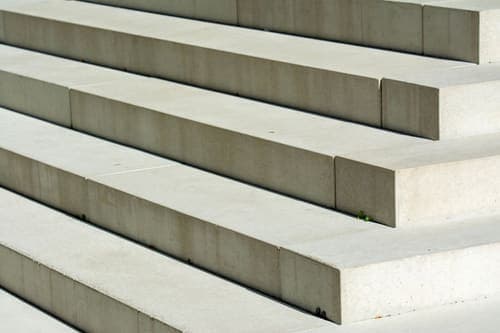
Concrete Step Repair
Concrete step repair is most of what I get called out for on stairs, because a full rebuild is usually more than the problem deserves. Broken nosings, treads flaking off grit every time somebody climbs them, a riser separating from the porch wall: all of that is fixable as long as the concrete behind the damage still rings solid under a hammer.
The repair starts with a saw cut, not a trowel. I cut the damaged edge back square to sound material, drill and epoxy short dowels into it, brush on a bonding coat, then form the nosing and pack a polymer-modified mortar in tight so there's no hollow under the tread. Feathered patches are the ones you see letting go on old concrete stairs all over town.
Thin edges have nothing to grip, and they lift the first winter the fog keeps them damp.
Hire a Visalia Concrete Contractor for this and the first thing worth settling is whether the damage is cosmetic or structural, because that changes everything after it.
What moves a concrete stair repair is the number of treads, how deep the rot goes once I chip it out, whether a handrail has to come off, and how much of the step is still worth saving.
Resurface Concrete Steps
We resurface concrete steps when the structure under them is still solid and only the top layer has gone chalky, flaky and rough underfoot. Tap the risers first. If they sound hollow, or a tread rocks when you stand on the edge, an overlay just cracks along the same line by fall and you have paid twice. That case is concrete stair repair, not a new skin.
Done properly, we open the old surface with a diamond cup grinder so the new material has teeth to grab, vacuum every bit of dust off, then scrub a bonding slurry into damp concrete and work the polymer-modified overlay in behind it while that slurry is still wet. Nosings get formed and rebuilt square, because a rounded, crumbled front edge is what people actually trip on. Traction goes in with a broom or a textured pad before it sets.
Afternoons here hit a hundred and five, and an overlay skinning over before you can trowel it is how you get a surface that peels in sheets, so this work goes in early and gets covered while it cures.
What moves the price on concrete stairs is the number of treads, how much nosing has to be rebuilt, and whether handrail posts need pulling and resetting.
What the job involves
What the job involves on a set of concrete stairs starts below the ground, not at the top step. We break out the old flight, haul it away, and put a footing under the bottom riser so the whole thing has something solid to sit on. Steel gets tied through that footing, up through the steps and into the landing, so the flight and the pad move together instead of going their separate ways.
Then forms, four inches of crushed rock tamped under the treads where the dirt is soft, and a pour we get done early, because on a 105 degree afternoon out here concrete stiffens faster than you can finish it and you wind up with a cold seam straight across a tread.
Risers are where sloppy work shows up. I keep every one within an eighth of an inch of the next, since a foot finds a half inch of difference long before your eye does, and that is how people end up on their back.
Step count, how high the total rise is, whether there is a landing or a rail to set, and how far we have to wheel wet concrete from the truck all change the work. So does what shape the old flight is in. Sometimes we resurface concrete steps instead, which is its own job further down the page.
What it costs
No two sets of concrete stairs price out the same, even when they have the same number of risers. What changes the number is how high the porch sits off the ground, how wide you want the treads, whether the flight drops straight or breaks at a landing, and whether we are forming a plain rectangle or flaring the bottom step into a curve. Forming is where the hours go.
There is a carpenter's worth of work in those boxes before a wheelbarrow ever shows up.
Access matters more than people expect. A front stoop we can back the truck up to is one thing. A flight behind a side gate means every load goes by hand, and that adds real time.
Tearing out and hauling off the old steps, cores for a railing, a colored or exposed finish instead of a broom, a deep pour in summer heat that needs extra hands on the trowel before it goes off, all of it shows up on the sheet.
Send us a photo and the height from grade to the porch and we will talk it through, then come out and put a real figure on your own flight.
The part we never shave to make a number look friendlier is the footing under the bottom riser. That is what keeps the stairs from walking away from your house.
When concrete stairs are the wrong fix
Sometimes concrete stairs are not the thing that fixes your problem, and I would rather say so standing in your yard than after the forms are up. If the bank behind the steps is creeping, new treads just ride the same dirt downhill. That slope needs a concrete retaining wall holding it first, and then steps have something solid to land against.
Other times the height itself can go away. One tall drop into a sunken back yard is an ankle hazard at night, and raising the grade with a new concrete patio at door level does more for you than a two tread set with a handrail bolted to it.
Same story at the garage. If the apron has settled and you step down into a lip, that is a concrete driveway repair, not a stair job stuck on top of a slab that is still moving.
If the complaint is really how the front looks, a stamped concrete landing and a clean nosing may be all of it.
Indoors, steps into a shop office are their own pour, and concrete polishing stops at the bottom tread, because a polished nosing plus wet shoes is a bad afternoon.
Why choose us for this
You have a set of concrete stairs that has been bugging you for two summers, and what you really want is to pay somebody once and then never give those steps another thought. That is a reasonable thing to want.
So here is where the cheap number usually comes apart. A low quote often leaves out tearing out and hauling away the old set, and leaves out the footing under the bottom riser. Both show up later, one as a line on the invoice and one as a crack across the second step about a year in.
We price demolition, haul-off and the footing in from the start, which is why our figure looks bigger on the phone and smaller when the job is done.
What moves the number is the count of risers, the total height you are climbing, how far a wheelbarrow has to travel from the truck, and whether railings are getting anchored into the new work.
One thing we will not do is strip the forms the same afternoon we pour just to clear the site, because green edges chip and you end up with rounded, sad nosings. In Visalia heat we keep them damp and covered instead.
Looking at your stairs and working up a number is free, and nothing about it obligates you to book.
Frequently asked questions
How long before I can walk on new concrete stairs?
About three days for normal foot traffic. We strip the forms the day after the pour, then keep the steps damp and covered for the first 48 hours, because a Visalia summer afternoon pulls water out of fresh concrete faster than it wants to go. Wait a week before you carry a fridge or a washer up them. Concrete keeps gaining strength for roughly a month after that.
Can you replace one broken step instead of the whole flight?
Sometimes, yes. If the steps below it are solid and only the tread has failed at the nose, a proper repair holds fine. If the whole set has settled toward the yard, or there are cracks running through more than one riser, rebuilding one step just pushes the problem up a tread and you pay twice.
Will tearing out the old steps damage my porch or doorway?
Not if the demolition is done carefully. We saw-cut the joint where the old stair meets the house and break the last foot by hand instead of putting a jackhammer against stucco or siding. The threshold and door get covered before anything loud starts.
What makes one stairway cost more than another?
Riser count first. Three steps up to a front door is a very different day than nine with a landing partway. Railing footings, narrow side-yard access that means wheelbarrowing every load, and hauling off the old set all add to it.
Contact Visalia Concrete Contractors now
You can reach us at (559) 316-5668, and the first thing we do as your local concrete contractors is come out and put a tape on the job instead of guessing at it over the phone.
What we are measuring is the total height from your door sill down to the walkway, because that number decides how many risers you get and whether every one of them ends up the same height. Uneven risers are what catch a toe.
We also dig a little at the bottom tread to see what the old set has been sitting on, check whether the soil has dropped away under it, and look at whether the mixer can reach the front of the house or the concrete has to come around the side in a wheelbarrow, one load at a time.
Things that change the shape of the job: the number of steps, how deep the footing has to go, whether a rail is coming back on, and whether an old set of concrete stairs has to be broken out and hauled off first. In the middle of summer we start early, because concrete stiffens fast here once the sun is up.
Weekdays, nine to five, a message gets called back by the owner. Licensed, bonded and insured, with paperwork you are welcome to see.