Spider cracks across the patio, a chipped step edge, a garage slab that has started to crumble at the corner.
Most concrete repair in Visalia starts the same way. You watched it through two summers of triple digits and one long tule fog season, figured it would hold, and now that one crack has brought friends. We fix concrete all over town: patios, walkways, garage and shop floors, driveway aprons, front steps.
One thing I refuse to do is trowel patch over a crack that is still moving. It telegraphs straight back through by the next hot stretch and you have paid for the same foot of concrete twice. Concrete crack repair only holds when the edges are sound underneath.
Price rides on square footage, how deep the damage runs, whether a mixer can get near the work, and how far you let it go.
Keep going for how concrete slab repair is actually done, when replacement beats patching, and what people ask first. Call and I will come look.
Concrete Crack Repair
Concrete crack repair is the call I take most often, and half the time somebody has already run a tube of hardware store caulk down the line. That never holds. A crack that moves will tear straight back through soft caulk by the next hot stretch, and now there's a gray smear on the slab as well as a crack.
The way we fix concrete cracks is to open them up first. We chase the crack with a diamond blade so it has clean walls and an even width, vacuum the dust out of it, set backer rod where it runs deep, then fill with a flexible polyurea that moves with the slab instead of fighting it. Sand broadcast into the wet filler kills the shine so the repair doesn't read like a scar across your driveway.
Total footage, how wide it has opened, whether the edges have broken down, and whether the slab is still shifting all move the number. Plenty of concrete repair companies skip the routing and just squeeze filler into a dirty crack, which is most of a day's work undone within a year. As a Visalia Concrete Contractor, I would rather do the prep properly than come back to the same line twice.
Concrete Lifting
Concrete lifting is how we rescue a slab that's still solid but has settled, and on a walkway or a garage approach it usually beats breaking the whole thing out. We drill ports about the size of a dime, inject structural polyurethane underneath, and let it expand until the panel comes back to level. Holes get patched, and the slab carries weight again the same afternoon.
How far it dropped, how many ports it takes, how easy the area is to reach with hose, and whether there's a leaking irrigation line feeding the void all change the number.
Rush it and you crack what you came to save. Too much foam through one port lifts the middle before the edges move, and now you're paying to fix concrete cracks that weren't there at breakfast. We lift in small shots with a level on the slab the whole time. Plenty of concrete repair companies skip lifting entirely and quote a tear-out, because demolition is easier to price than judgment.
Mudjacking
Mudjacking is how I put a sunken slab back where it belongs without breaking it out. We drill a line of holes through the concrete, roughly quarter sized, then pump a wet sand and cement slurry underneath and watch the slab climb back to level a fraction of an inch at a time. The holes get packed and troweled flush when it's sitting right.
Rushed, it goes wrong fast. Pump too hard and you crack the slab from below, which turns a lifting job into a real concrete repair. So we lift in stages with a level on the slab and stop when it meets its neighbor.
Most sunken slabs here sit on clay that shrinks in the dry stretch, or on soil a leaking irrigation line washed out. We find where the dirt went before we pump anything.
Slab size, how far it dropped, hole count and how close we can park the pump all move the price.
Concrete Spalling Repair
Concrete spalling repair is what you're after when the top layer of a slab is flaking off in patches and sheets, leaving the rough aggregate staring back at you. Around here it usually starts one of two ways: a slab troweled with water flicked on the surface during a hundred-degree afternoon, so that top skin never really bonded to what's underneath, or shallow rebar that rusted and pushed the surface off from below. This isn't a concrete leveling problem.
The slab sits exactly where it always did. The first half inch is just quitting.
We saw a square edge around the damage instead of feathering a patch out to nothing, chip back until we're hitting sound concrete, clean and treat any steel we find, then bond and place a polymer-modified mortar and match your finish.
I won't trowel a skim coat over hollow concrete. It looks great for a season, then lets go and takes more slab with it.
Depth, square footage, whether rusted steel is in play, and how close we can bring a saw and grinder to the work are what move a concrete repair like this one way or the other.
Epoxy Concrete Repair
Epoxy concrete repair is the one that actually bonds a slab back together, which makes it structural rather than cosmetic. We chase the crack clean, set injection ports along it, seal the face so the resin stays where it belongs, then pump low-viscosity epoxy under pressure until it comes up at the next port. Cured, it is stronger than the concrete around it.
That is also why a sloppy injection announces itself: pump resin into a damp or dusty crack and it bonds to nothing, and you get a fresh split an inch to the side by fall.
Heat matters here too. At 105 degrees the pot life drops off a cliff, so we mix small and inject early in the day.
Epoxy is the wrong tool for a slab that has sunk or still moves, which is concrete leveling work instead. Linear footage, slab thickness, vertical versus flat surfaces and how much grinding prep the concrete repair needs are what change the number.
What the job involves
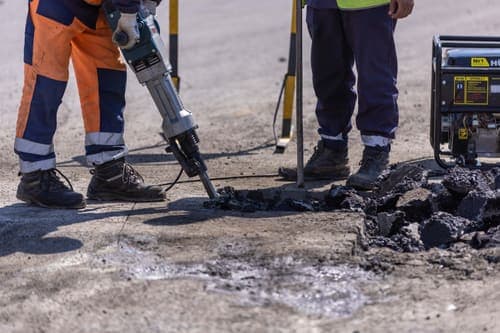
Concrete repair starts with me tapping around the damage with a hammer before anything gets mixed. Sound concrete rings. Bad concrete thuds, and that dull patch tells me how far past the visible damage the failure actually runs, which is usually further than anyone wants to hear.
From there we saw cut the edge square instead of feathering the patch out to nothing, because a thin feathered edge breaks off under the first tire that rolls over it. We clean it, drill and pin where the patch needs something to hold onto, bond it, and place material that matches the thickness we cut. On a slab that has settled but is otherwise solid, concrete lifting puts it back to grade without breaking anything out.
Most single areas take a day. Depth, access for the truck, and how much sound concrete we lose getting to the bad stuff all move the number.
In summer heat we start early and keep the patch damp so it cures instead of flashing off.
What it costs
Concrete repair gets priced off a few things I can't eyeball down the phone: how much of the slab is actually bad, how deep the damage runs, and whether my truck can get close enough to work or we're carrying material through a side gate by hand.
Depth is the big one. Surface flaking on a patio is one job. A slab broken into five pieces with soft, crumbly edges is another, because all the bad concrete has to come off before anything new goes down. Mudjacking is priced differently again, since the void under a sunken walk decides how much slurry it drinks, and nobody knows that number until the pump is running.
Access, square footage, and what caused the settling in the first place all push it around.
Call us and we'll come look at your slab and give you a real figure for it.
Wet ground under concrete will sink it again, so I'd rather find the water than patch twice.
When concrete repair is the wrong fix
Sometimes concrete repair is the wrong call, and we would rather say so while we are standing on the slab with you.
If a section has broken into four or five pieces and rocks under your boot, lifting it just rearranges the rubble. That one wants concrete removal and a fresh pour over a properly prepped bed. Same story with a concrete sidewalk that a tree root has been pushing up for years. Patch the lip and the root keeps growing all summer, right back into the same hump. We cut the panel out, deal with the root, then pour it back.
Surface trouble is another matter. Sound underneath, gray and pitted on top across the whole thing? Concrete resurfacing handles that in one pass instead of forty little patches that never match. And on a concrete pool deck gone hollow from a leak, fix the water first, or you pay the concrete leveling cost twice.
Why choose us for this
You have a slab with something wrong with it, and what you actually want from concrete repair is to hire somebody once, not supervise them, and not think about that slab again for years. Fair enough.
Most of what goes wrong in this trade happens before anybody mixes anything. A number given over the phone that swells by the time the invoice shows up. A crew that opens a second job across town while yours sits half torn out. Somebody leaning on you to sign today because the price moves tomorrow.
The cheaper quote usually leaves out cutting the failed concrete back to sound material and hauling the broken pieces off, so the patch ends up bonded to crumbs. Your concrete leveling cost shifts with how far the slab dropped, how much empty space sits under it, and how tight the access is along the side of the house. Hardpan under this part of town makes that last one interesting.
Come look at it, no charge, and no obligation to book anything after.
Frequently asked questions
Can you repair my concrete, or does the slab need to come out?
Most of the time concrete repair is the right call, and the test is what's under the damage. If the slab is still one solid piece sitting on ground that hasn't moved, we patch, grind, lift or fill and you keep the concrete you already paid for. If it's broken into pieces that move when you step across them, or the surface is gone over most of it, a patch is money you spend twice.
How long does concrete spalling repair actually hold?
Years, as long as the bond is right. We take the flaking layer off down to sound concrete, clean it, prime it, then lay a polymer-modified mortar and finish it to match the texture around it. Skip the prep and it sheets off the first hot stretch when the slab is pushing 140 degrees at the surface.
Will the patch match the rest of my driveway?
Close, not invisible. New material cures lighter, and your existing concrete has years of sun and tires on it. It tightens up over a few months, and a sealer pulls the tone together. If you want it uniform, resurfacing the whole slab is the honest route.
Contact Visalia Concrete Contractors now
If a cracked patio or a sunken garage slab has been sitting on your list since summer, that is exactly what Visalia concrete contractors are for, and it takes about five minutes on the phone to find out whether the thing is fixable. Most concrete repair calls I take go the same way: you describe it, I come out, I put my boot on it and see whether it moves.
What I will not do is judge concrete slab repair off a photo. Depth matters. How much of the slab has gone hollow underneath matters. Whether a mixer can reach the back yard or the whole pour goes by wheelbarrow through a side gate matters. So does the time of year, because patch material sets a lot faster in July than it does in February.
Call (559) 316-5668 weekdays, nine to five. If I am on a pour, leave a message and you will hear back.