Tree root lifted one panel, the next one dropped, and now everybody steps into the grass to get by.
If your concrete sidewalk has gone crooked enough that people walk around it, you are on the right page. We pour, replace and straighten walks all over Visalia, from the shaded older streets near downtown where sycamore roots do most of the lifting, to the newer tracts where soft ground let a thin slab settle at one end. Sometimes sidewalk leveling is the answer and a panel goes back where it belongs.
Sometimes that panel is broken in four spots, and lifting it just gets you four level pieces. I will not pour fresh concrete over a live root, either, because that same lip shows up again in about three summers.
Size, truck access, how deep the old work runs, roots, water lines and the time of year all move the number. Keep going for how concrete sidewalk installation is done, where we work, and the questions that come up most. Call us and we will come take a look.
Concrete Walkway
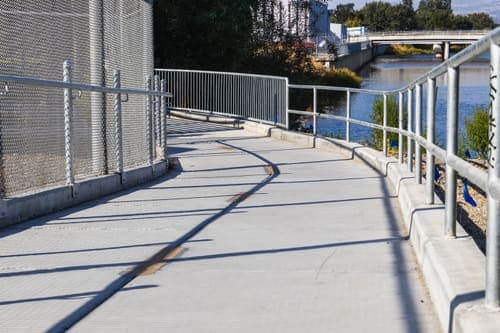
A concrete walkway is the path you actually use, driveway to front door or down the side of the house to the back gate, and it gets built a little differently than the public concrete sidewalk out by the curb. Four inches over crushed rock, joints cut in early so the slab cracks where I tell it to instead of wherever it feels like.
I pour paths wide enough for two people to walk side by side, because the skinny ribbon nobody uses is the one that ends up with dead grass down both sides of it.
Size, access and tree roots move the cost more than anything. A three foot side gate means every yard of concrete comes through in a wheelbarrow, and the old ash and mulberry roots in the established neighborhoods have to be cut and dealt with before we form. Most straight runs our concrete contractors company pours takes a day, and you're back up overnight.
If one panel has heaved on a root and the rest is flat and sound, sidewalk leveling beats ripping the whole thing out.
Gutter Curb
Gutter curb is the part nobody thinks about until water sits out front for two days after a storm. It's the shallow pan at the street edge that carries runoff along to the catch basin, and if your concrete walkway and driveway drain toward the street, that pan is the last stop.
Visalia is flat enough that a half inch of wrong fall in a twenty foot run will park a puddle there all week, and mosquitoes find it before you do.
When we replace a section, we saw cut back to the nearest joint instead of breaking out to a ragged edge, take the pan and the curb face together, then shoot grade off the flow line on both sides so the new piece matches what's already running. Dowels into the old concrete keep it from settling alone later.
Length of the run, how much broken concrete leaves in the truck, and whether the street needs cones and a flagger all push the price around.
Concrete Sidewalk Repair
Most concrete sidewalk repair I get called out for is one panel, not the whole run: a lifted edge somebody caught a toe on, a corner broken off at the drive approach, a slab that sank until water sits on it for a day after rain. A small lift I can grind flat and leave safe.
Past about an inch of displacement, or a panel cracked into four pieces, it comes out clean at the joints and goes back four inches over rock, with the offending root cut back and a barrier set so it doesn't have another run at you.
Troweling patch material across a section that's already breaking up underneath is money gone. It lets go inside a season and takes sound concrete with it.
Panel count, how far a wheelbarrow has to travel down a side yard, and what the roots have been doing all move a repair the same way they move the cost to install concrete sidewalk new. Matching an old stamped concrete walkway takes longer than matching a broom finish.
Concrete Sidewalk Installation
Concrete sidewalk installation is mostly what happens before any concrete shows up. We cut the line, strip the loose material, and set a crushed rock base we can run a plate over, because a walk poured straight onto soft fill cracks in the first hot stretch and then one side drops at the joint. Forms get staked to grade so runoff heads away from the house instead of pooling against the stem wall.
Then four inches of concrete, joints tooled in so the cracks land where we put them, and a broom finish that still has grip when the sprinklers overshoot at six in the morning.
Want something other than flat gray out front? A stamped concrete walkway uses the same base work underneath and adds time for the pattern, color and sealer.
Cost swings on length and width, whether the truck can chute it or we are barrowing down a narrow side yard, tree roots, and the old walk we break out and haul away.
What the job involves
A concrete sidewalk is mostly the part you never see once we're done. We cut and haul out the old panels, dig down for base rock, tamp it until it quits moving, then set forms to a string line with a little fall on them so water runs off instead of sitting against your door. Four inches of mix, screeded flat, broom finish for grip.
Joints get cut the same day, deep enough to decide where the slab cracks, because it's going to crack somewhere and I'd rather pick the spot than let the concrete pick it.
Most front runs take a day, and you're back up overnight.
What stretches a job is length, how far the truck can get from the pour, whether ash roots have got under the old panels, and whether we're tying into concrete curbs at the street. Roots are the one that surprises people. Cut them wrong and the tree tells you about it for years.
What it costs
What it costs for a concrete sidewalk comes down to a few things I can size up in ten minutes with a tape measure in my hand. Square footage first, then thickness, then whatever is already sitting there. Breaking out an old walk and hauling the chunks off is real labor and it shows on the quote. Access counts too.
If the truck can get close to the forms, that's cheaper than barrowing every load down the side of the house past the AC unit. Roots from an old street tree mean hand digging and sometimes reshaping the run around them. Concrete curbs tied into the edge, a colored or exposed finish, a fussy landing at the front step, all of that adds.
Call us with a rough length and width and we'll talk through a real number for your property rather than a guess off the internet.
Summer heat doesn't change the price, it changes the day: smaller sections, earlier pours, so the surface isn't stiffening while we're still finishing it.
When concrete sidewalk is the wrong fix
Sometimes a concrete sidewalk is the wrong call, and pouring one anyway just buys you a crack in a brand new place. If cars cross it to reach the garage, a four inch walking slab splits along the tire line inside a season or two. That run wants the depth and thickened edge of a concrete driveway, not a path with delusions of grandeur.
If the ground drops more than a step between the gate and the front door, ramping the walk to meet it gives you a slope nobody wants to carry groceries down. Concrete stairs with a real landing are what that grade calls for.
Water chewing at the street edge is not a path problem either, that is concrete curb installation, and a clean new walk beside a sagging curb only makes the curb look worse.
And if the slab bothering you is the shop floor, grinding and sealing it beats demolition. Concrete polishing works on what you already have. Same goes for the backyard: a concrete patio, stamped concrete if you want pattern, serves you better than more gray ribbon to the mailbox.
Why choose us for this
You've got a stretch of concrete sidewalk that's lifted at a joint or gone to spiderweb cracks, and honestly the annoying part isn't the concrete, it's having to think about it at all. You want it handled once, by someone you don't have to stand over, and then you want it off your list for a decade.
The cheaper number usually gets there by leaving something off the sheet: a thin pour, no cut and removal of the loose ground underneath, forms stripped before the slab has any strength in it. That looks fine through fall and starts moving on you by the second summer. I've been pouring flatwork here for over 12 years and I won't set concrete on ground that hasn't been dug out and rolled tight, because that's the slab that sinks.
Length, how tight the access is, tree roots, and whether the run ties into concrete curb installation all move the number. Having me come measure puts you under no obligation to book anything.
Frequently asked questions
How thick does a concrete sidewalk need to be?
Four inches for a residential concrete sidewalk, poured over rock that's been graded and rolled tight first. Where the walk crosses a driveway and takes vehicle weight, I run it six inches with steel through the crossing. Three inches saves a little material and cracks at the panel corners by the second summer. The roots lifted my old walk. Won't they just lift the new one? Not if the roots get dealt with during demo. We cut back the offenders, set a root barrier along the tree side, and pour a full-depth panel rather than feathering over what's left. On an ash or a liquidambar out front, that buys you years instead of months.
Do I need city approval to replace the walk in front of my house?
Usually yes, because that strip and the gutter curb next to it sit in the public right of way. Permit work, inspection timing and access all move the price, and we handle the paperwork side before anyone breaks concrete.
Contact Visalia Concrete Contractors now
Call the Visalia concrete contractors who will walk the whole length of it before saying a word about the work, because one sunk panel and eight of them are two very different afternoons.
When you get hold of me, have a rough picture ready: how many panels are bad, how high the lifted edge sits above its neighbor, and whether there's a tree in the strip beside it.
Roots off the older ash and sycamore trees around here push up more slabs than anything else does, and if we don't cut that root back and set a barrier before we pour, the new panel lifts the same way and you are back where you started.
I will say plainly whether this is concrete sidewalk repair, a couple of squares out and back in, or the full run. If the work sits in the city right of way, there's a permit step and that paperwork is mine to deal with, not yours.
Weekdays, nine to five. Leave a message and you will hear back from the person who does the pouring.