You want a new pad poured for a patio, a shop or an addition, or the one you have is breaking up underfoot.
Most people figure a concrete slab is the easy pour. Gray pudding in a wooden box, drag a board over it, go have lunch. You can do it that way. Two summers later there's a crack wandering corner to corner and the patio chairs are sitting at an angle nobody ordered.
We pour slabs all over Visalia and the towns around it: house pads, patios, shop floors, garage additions, equipment pads out at the dairies. Dirt work comes first, every time. What never happens on my jobs is concrete going down over loose fill because somebody wanted to save an hour of machine time. Soft ground under four inches of concrete is a crack you've already paid for, you just haven't seen it yet.
There are concrete slab contractors who will form and pour whatever you point at. We look at the ground first and say so if it needs cutting, wetting and rolling tight. We work as concrete footing contractors too, so the same crew that digs the trench pours what sits on top of it.
In summer the truck is here at first light, because once it's triple digits the mix stiffens faster than a crew can finish it.
Size swings the concrete slab cost further than anything else, then how close the mixer can get, how thick it needs to be, and what's sitting on the spot right now.
Keep reading for how the work actually goes, the money, the towns we cover, and the questions that come up most. Or call and I can come stand on it with you.
Concrete Footings
Concrete footings are the part of the job nobody ever sees and the part that decides whether your pad is still flat in ten years. On most work we pour them monolithic with the slab, a thickened edge turned down around the perimeter with steel tied through it, so the pad and its footing go off in one pour. Garage additions, patio cover posts and anything carrying a roof load get their own pads, dug deeper and wider.
Clay around here does what clay does. It swells with the winter rain and shrinks tight through a dry Visalia summer. A footing that stops short in soft fill rides that movement, and you get the crack running from a corner straight across the pad, usually inside a season or two of the pour.
So we trench down to firm ground rather than to whatever depth is convenient, and we chair the rebar up off the dirt. Steel laid flat in the bottom of a trench draws moisture, rusts, expands and blows the face off years later.
A concrete slab for a shed usually needs nothing more than a turndown edge. Depth of the dig, hardpan that wants a machine, and how far the spoil has to travel are what move slab foundation cost, not the concrete. Footings come as part of our local concrete contractors service, one crew from trench to finish.
What the job involves
Most of a concrete slab job happens before any concrete shows up. We strip the sod and the soft topsoil, dig down to firm ground, then bring in crushed rock and run the tamper over it in damp lifts until it stops moving under a boot. Hardpan under a lot of yards around town is a gift. Loose fill somebody dumped in a side yard forty years ago is not, and that has to leave in a trailer.
Then forms, set so water runs away from the house instead of toward it. Steel gets tied and sat up on chairs so it ends up inside the pour rather than lying in the dirt accomplishing nothing. Under a slab foundation we lay plastic, because moisture will find its way up through your flooring otherwise. A concrete slab for shed is a simpler animal: thicker around the perimeter, mesh through the middle, done.
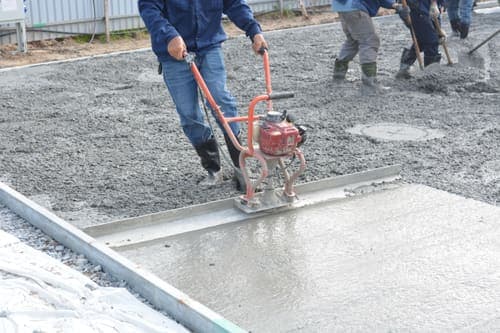
The pour itself takes a day. On a 105 degree afternoon the mix goes off quick, so we start early, screed, float, and wait for the bleed water to leave before troweling. Finish it too soon and you trap that water, and the top surface flakes off in a couple of years. Joints get cut so it cracks where we chose. Stay off it on foot for a day, keep the car off for a week.
Size, thickness, truck access and how much dirt leaves the property all pull the number around.
What it costs
What it costs to put in a concrete slab comes down to about six things, and I can walk all six with you in ten minutes on site. Square footage first. Then thickness, because four inches is plenty under a patio and a shop floor that parks a dually or a two-post lift wants more. Then how much dirt comes off the top and where it goes, since ground sitting low needs fill brought in and that's trucks.
Access is next: if the mixer can chute straight into the forms it's cheap, and if the mud has to be pumped over the roof or walked around the house in buckets, that's hours of labor nobody can wish away.
Steel matters too, mesh versus rebar tied up on chairs. And an interior concrete foundation pour needs a vapor barrier and edge detail that a back patio simply doesn't, so those two jobs never price the same.
Then there's our dirt. Heavy clay out here moves with moisture, and a slab foundation poured on ground that wasn't prepped right will crack on its own schedule, usually along the line where you didn't want it. Summer is its own factor as well, since a 105-degree day means early starts and water on the surface, not a crew racing the set.
Call me with the size and the spot and I'll give you a real figure for your job.
When concrete slab is the wrong fix
Sometimes a new concrete slab is the wrong fix, and you deserve to hear that before the saw comes off the truck.
If the pour underneath is solid and only the top skin is flaking off, ripping it out is overkill. Concrete resurfacing bonds a fresh wear surface to sound concrete and you keep the slab you already paid for once. One tight crack with no lip to catch a shoe is concrete repair, an hour with a grinder and the right material, not a demolition project.
Settlement is the one people get wrong. A corner drops because water is moving soil under it, and if we pour a beautiful new pad over that same wet path, it drops too. The drainage gets sorted first or nothing else matters.
Around a pool, the spec changes. A concrete pool deck needs fall away from the coping and a finish that still has grip when it is wet and covered in kids, so a flat broom pour off a patio plan is the wrong answer there.
The square between your lawn and the street is a concrete sidewalk, which means city rules, and that gets handled as its own job.
And if you want a real concrete slab foundation for a shop or an addition, that is thickened edge, steel and a concrete foundation built to carry walls. Old pad in the way? Concrete removal comes first. Pouring over broken concrete just prints the old cracks upward.
Why choose us for this
You have a patch of ground that needs a concrete slab poured on it, and what you really want is to hire one crew, once, and not think about that piece of your property again for twenty years.
The part that usually goes sideways is not the trowel work. It is the number. Anybody who gives you a figure over the phone is guessing at your dirt, and the guess gets corrected later on the invoice.
Size, thickness, how much soil comes off the top, whether a truck can back a chute close or everything moves by hand through a gate, what is sitting there already: those change the job, and I would rather walk it with you before either of us agrees to anything.
Here is where the cheaper bid on a concrete slab foundation tends to get cheap. Thin the pour by half an inch. Mesh in the middle instead of rebar tied and chaired. No vapor barrier under a shop floor. Fill dumped in and leveled but never run in lifts, which cracks in a straight line that follows the soft spot inside two summers.
Over twelve years of doing this, that last one is what I see most, and it is not fixable afterward.
We also pour early in the day through a Visalia summer, because a slab that flashes off at a hundred and four degrees loses its surface.
The estimate costs nothing and books nothing.
Frequently asked questions
How thick does a concrete slab need to be?
Four inches over a well packed rock layer is right for a patio, a walkway or a standard garage floor. Where a truck, an RV or a loaded trailer parks, we go five or six inches with steel in it. Pour it thin and you get a crack straight across the middle in the first year, and no sealer or overlay fixes that after the fact.
What's the difference between a slab and concrete footings?
The slab is the flat part you stand on. Concrete footings are the deeper trenches under bearing walls and posts that carry the weight down to firm ground below the loose topsoil. A patio or a shed pad usually needs none. An addition, a shop or an attached garage does, and that's the work concrete foundation contractors get called back for when somebody poured flat and hoped.
Does summer heat hurt a fresh pour?
It can, so we start at first light through the hot months. When it's over 100, water leaves the surface faster than the mix sets and you end up with hairline crazing and a chalky top that dusts under your shoes. We keep it wet-cured and covered, walk-on the next day, vehicles off it for a week.
What makes one pour cost more than another?
Thickness and square footage first, then how close the truck can get. Hand-hauling material to a back yard turns a short pour into a long one. Breaking out and removing old concrete, adding steel, and how much dirt has to move before we set forms all push it up.
Contact Visalia Concrete Contractors now
If you have been putting off calling Visalia concrete contractors because you are not sure what you actually need, one phone call sorts it out faster than another week of walking the backyard with a tape measure.
Tell us what the concrete slab is for, a shed pad, RV parking, a patio, a shop floor, and roughly how big it is, and we can usually tell you over the phone whether that is a straightforward pour or something with real dirt work under it.
Then we come out and look at the ground. Photos never show how a yard drains, where the downspouts empty, or whether that corner sits low enough to hold water against the house every time it rains.
We also check how a mixer truck gets to the spot, because chuting straight off the truck and hauling concrete across a lawn by hand are two different days of work, and on some of the older lots near downtown the driveway decides that for us.
Footings come up on the same visit more often than not. Half the people looking for concrete footing contractors are really after a patio cover, a room addition, or a post base somebody set too shallow years back.
Size, thickness, how much digging, and how close a truck can get all pull the concrete slab cost in different directions, and we walk through every bit of it on site.
Weekdays, nine to five. Leave a message outside that and you get a call back from the owner.