Old glue lines, mop streaks, and a slab that still looks dirty five minutes after you clean it.
Concrete polishing is the rare job where the floor you actually want is already down there under your feet, and my crew just grinds until it shows up. We put polished concrete floors into shops, showrooms, tasting rooms, warehouse aisles and plenty of home kitchens around Visalia, usually on slabs the owner had written off.
Here is what the work looks like from your side of it. Dry grinding runs through a vacuum shroud, so the dust goes into a filter instead of into your inventory. Wet grinding throws slurry, and that slurry gets squeegeed and hauled off, not hosed toward the nearest drain. We mask doorways and tape off everything we are not touching, because the grit travels.
What changes the number is square footage, how much carpet glue or thinset has to come off first, how shiny you want it, and whether we are working around racking or an empty room.
Keep reading for the method, the money, when polishing is the wrong call, and the usual questions. Or call and I will come look at the slab.
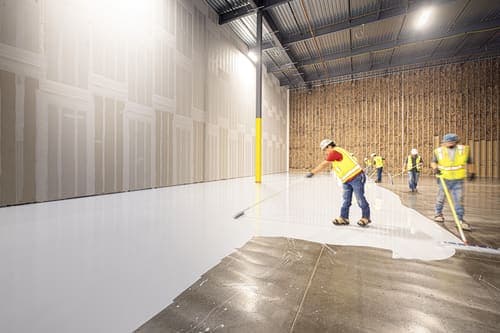
Polished Concrete Floors
Polished concrete floors aren't a coating. We grind the slab down with diamond tooling and refine it until the concrete itself is the finish, which is why there's nothing on top to peel, flake or bubble later.
The work starts with metal-bond diamonds, usually 30 or 40 grit, cutting through the soft cream on top and whatever the old vinyl glue left behind. Then a lithium silicate densifier soaks into the open surface to harden it, and we climb through resin grits, seven or eight passes, up to a matte sheen or a full reflective one depending on what you're after.
Skip a grit to save an afternoon and you get swirl scratches nobody sees under a shop light and everybody sees the day the showroom lights go on.
Concrete polishing runs on square footage, how deep we have to cut, and what the slab's been through. Old mastic, paint and carpet tack scars all add passes.
Downtown shops and ag offices make up a good part of our local concrete contractors service, and if you want color in it, stained concrete floors get polished the same way once the dye is set.
Stained Concrete Floors
Stained concrete floors are the other job I do with the same grinder, and they start where concrete polishing starts: open the slab up and see what you actually have under the carpet glue. Acid stain reacts with the lime in the concrete, so the color mottles and shifts and never repeats twice. Water based dye lands more even and gives you colors concrete has no business being. Neither one hides anything.
Old mastic, curing compound, a patch somebody troweled in over a plumbing repair, all of it takes stain differently and shows up the day the floor dries.
So the grinding comes first, every time, and then the color.
Acid stain also has to be neutralized and rinsed until the rinse water runs clear. Skip that and the concrete sealing on top never bonds properly, and you get sealer peeling off in sheets inside a year with your color still stuck to the back of it.
What moves the money on a stained floor is square footage, how much adhesive has to come off before we start, whether you want one color or a border, and how many coats go over the top.
Concrete Sealing
Concrete sealing on a polished floor is not a shiny film rolled over the top, and anybody selling it that way is setting you up for a strip job later. Once the concrete polishing is done to the grit we agreed on, the slab gets a lithium densifier that reacts down in the pores and hardens the surface, then an impregnating guard that keeps oil, wine and brake fluid sitting up top long enough for you to wipe them.
A topical acrylic on a polished slab scuffs white in the traffic lanes inside a year, and getting it off means grinding again.
Plenty of polished concrete contractors quote the grind and leave the guard off the sheet entirely. That gap shows up in year two as dull tracks where everybody walks.
Square footage, how much furniture or racking has to shift, and whatever is already stuck to the slab, old mastic, curing compound, a previous coating, all push the cost around.
A shop floor wants resealing every two or three years. A quiet front room goes considerably longer. You get the floor back up overnight.
What the job involves
Concrete polishing isn't one pass with a buffer. It is a stack of grinding steps, usually seven or eight, starting with coarse metal bond diamonds that cut the slab flat and finishing with fine resins that pull the shine up out of the concrete itself. Somewhere in the middle we scrub in a lithium densifier, so the surface hardens all the way through instead of sitting on top as a film waiting to peel.
Before any of that, the floor has to be stripped. Old carpet glue, tile mastic, a failing epoxy in a shop bay: all of it comes off first, and that is the part that turns a two day floor into a four day one. Our grinders run with vacuums attached, so most of the dust ends up in a bag rather than on your shelving.
The finish you pick changes the work more than the square footage does. A cream finish stays near the top. Salt and pepper means cutting deeper. Full aggregate means deeper again, and any low spot in the slab shows itself. Depth, glue removal and gloss level are what polished concrete contractors should be looking at before quoting anything.
What it costs
What concrete polishing costs comes down to what's already stuck to your slab, how much floor there is, and how far down the shine you want to go.
Size cuts both ways. A wide open warehouse bay runs cheaper per foot than a chopped up office with columns, doorways and toe kicks, because every edge is ground by hand and hand work is slow. Then there's whatever is bonded to the concrete. Carpet glue, black mastic under old vinyl tile, epoxy somebody rolled on years ago, all of it has to come off before the first real pass, and that's the part people don't budget for.
Gloss level moves the number too. A satin floor stops several grits short of a mirror, and each extra step is another full pass across every square inch. So does depth of cut: leaving the cream on top is one job, opening the slab up to show the rock underneath is another.
Call us with the square footage and tell us what's on the floor now. A concrete floor polishing company quoting sight unseen is guessing, and glue doesn't show up over the phone.
When concrete polishing is the wrong fix
Concrete polishing belongs indoors, and I turn the outdoor calls down. Polish a concrete driveway and you have built yourself a slip hazard that goes dull in a couple of Visalia summers anyway. Same story with a concrete patio out back: what makes sense there is stamped concrete on a fresh pour, or a broom finish with a good sealer on the one you already have.
And no, we don't polish a concrete retaining wall, though somebody asks about twice a year.
Inside, the mistake I see is grinding a floor that is already failing. If the concrete slab has cracks that step up at one edge, a corner sitting low, or the top flaking away in patches, polishing hands you a shinier version of the same problem inside a year. The diamonds take off about an eighth of an inch. They do nothing about movement underneath.
That is a repair or a tear-out, and access, square footage and how bad it has gotten all move what it takes.
Soft, overwatered floors are the other one. Grind those and you expose sand, and the finish comes up blotchy. Better you hear that before you hire a concrete floor polishing company than after.
Why choose us for this
You've got a slab you'd like to actually look at, and the last thing you want is to go through concrete polishing twice. Fair enough.
The low quote usually gets there by skipping grit steps. A crew runs the metal bonds, jumps straight to a high resin, throws down a guard, and it gleams on day one. Six months of pallet jacks later the scratch pattern shows through and the doorways go hazy. Those middle passes are hours nobody ever sees, and they're the reason a floor still reads clean in year three.
I also won't grind dry without containment. Concrete dust is fine enough to find your vents, your stock and the top of every shelf, so our grinders run to HEPA vacuums and the openings get taped off before a machine touches the floor.
Over 12 years doing this, the things that move what a polished floor costs are the square footage, how much old mastic or epoxy has to come off first, how soft the slab turns out to be, and how much hand edge work is waiting at the walls.
A walkthrough and an estimate cost you nothing, and agreeing to one isn't agreeing to the job.
Frequently asked questions
Will polishing crack my existing slab?
Concrete polishing doesn't crack a sound slab. We're taking a sixteenth to an eighth of an inch off the top with diamond tooling, not loading it or shocking it. What we check before anything else is whether the surface is delaminated or soft from a fast pour, because weak cream tears out under the first metal-bond diamonds and leaves pockmarks you can't grind away. If your floor is in that shape, you'll hear it from me before we go any further.
How many days is my floor out of use?
Figure two to three days for around a thousand square feet, and longer if we're chasing out old tile mastic or carpet glue before the first cut. The grinders run on vacuums, so most of the dust goes down a hose instead of onto your shelves. There's no cure time waiting at the end either. Once the final pass is done, you can walk on it.
What's the difference between polishing and just sealing the floor?
A sealer is a film on top of the concrete, and film wears through where the forklift turns or the front door swings. Polishing hardens the slab itself with a densifier, then brings the gloss up mechanically through finer and finer grits. The shine is the concrete, not a coating sitting on it.
Contact Visalia Concrete Contractors now
Call the Visalia concrete contractors who'll put a grinder on the slab before saying anything definite about it, because with concrete polishing a wet patch test in one corner tells me more than twenty minutes on the phone ever will. I want to see how hard the slab has gone, what's glued to it, and whether the pour was troweled tight or left open.
Have a rough footage in your head when you call, plus the age of the slab and what's covering it now. Carpet glue, mastic, thinset, epoxy that somebody rolled on in a hurry: all of that changes the first cut and how many passes it takes to get past it.
Two other things worth mentioning: where the nearest power drop is, and how wide the doorway is. A shop floor off Akers that only opens through a three foot man door means smaller machines and a longer week.
We work through the week, and if the phone goes to a message it gets returned. Licensed, bonded and insured, with the certificate available if you want to see it.